
StoryTime: The Old World Is Dead. Accept it.


We are never going back to the way things were.
So, what exactly are we fighting for now?
“Step back. Pause. Rethink.”
The relaunch of LiteralMayhem is barely a couple of months along now, but if we had to put a stake in the ground as an editorial mantra, that would be it.
There are many Substacks, blogs, and news+opinion sites to give you rapid-fire takes on the latest spaghetti-flinging edicts coming out of Washington. Many of those sites offer excellent big-picture takes on the current crisis from the viewpoints of economics, political science, and history. We subscribe to a bunch of them; we reference their content and research; and we rely on their expert analysis and insights. (There’s a list of recommendations in the home page sidebar.)
It’s also very easy, understandable even, to open the faucet full blast to keep up with, and stay fired up about, the unfolding political and economic shitshow that’s been flooding the airwaves and the internet’s tubes and pipes. There are many battles to engage. Lots of incoming fire to deflect. A great deal of shoe leather to be burned at marches and protests, and hotlines to be manned, and chants to be shouted, and actions to be taken.
But LiteralMayhem isn’t trying to squeeze into those lanes. Those writers are better at it and have a lot more resources.
Our fascination here is “narrative,” writ large, or more simply put: story. Generally speaking, the stories we believe in—those to which we hold true—move our actions in the real world. And the stories at the heart of identity weave together to form the stories that define our social fabric and our shared reality.
In that spirit, we’d observe that it often takes a moment of stepping back and rethinking to fully grasp the full sweep of the stories, the shared narratives, that are playing out on the stage of real life.
In his book, The Science of Stories, the social psychologist János László writes:
Every society has its own ‘historically crystalized’ stories or story frames… A recounted story, that is, the way people give a sense of meaning to the events of their environment, expresses their inner state and their interrelationships. In the same way, canonized or representative stories of a group provide information about the values and norms prevailing in the group, about the ways of coping accepted in it, about the properties of group identity.
At the moment, the defining feature of our shared reality is what one could call “narrative warfare.” Here in the U.S., that narrative warfare is playing out as a pitched battle between two completely different ways of explaining the world:
Narrative A: The Trump administration is finally giving America a long-overdue and much-needed, radical realignment of government priorities, streamlining decision making and shrinking government to make it more efficient and accountable. Government is too big, too bloated, too tyrannical, and they are fixing it all by removing bureaucratic obstacles and entrenched interests that want to enforce their out-of-touch, anti-American ideology on everyday Americans. The administration is also prioritizing American interests above international interests that cost too much and return too little, and they’re using the nation’s full political and economic power to get more for the American taxpayer. They are championing individual liberty here at home and refocusing the agencies of law and order to hold to account those who have misused the government to launch “woke,” radical, racialist attacks on political foes, free expression, and individual and religious liberty. And they are going to bat for American business, aiming to power growth and innovation by reducing the heavy hand of regulation and fighting anti-competitive behavior of other nations. This is the beginning of an American resurgence that gets our nation back on the right (i.e., conservative) track toward personal and economic liberty.
Narrative B: The Trump administration is gutting American democracy in an unprecedented autocratic power grab. They are removing all obstacles to authoritarian control by gutting independent offices of accountability (e.g., Inspectors General, Boards of Governors, Joint Chiefs, etc,) defanging critical media, and defunding education. They are assaulting the separation of powers, as well as trying to control and intimidate the judiciary, in a naked effort to centralize state power in the person of the executive. They are purging apolitical career civil servants to install political loyalists answerable to the executive, rather than to American citizens and the Constitution—in the process destroying essential capabilities and expertise that have taken decades to build. They are memory holing critical data and information, especially scientific information: holding truth hostage to ideology. They are intentionally creating chaos to distract from their autocratic aims, and they’re on the verge of leaving tens of millions of Americans destitute in an effort to deliver more wealth and economic/political power to wealthy and corporate benefactors. This is a crisis moment, in which a lying power-hungry elite is seizing control of the most powerful democracy on Earth, supplanting the will of the people for their own benefit, to install themselves as a permanent kleptocratic oligarchy.
The clash of these two storylines is tearing at the heart of social cohesion, the purpose and role of government, all manner of social institutions, the stability of democracy, and one could even say, the very definition of “humanity” (i.e., what it is, and who has it).
Is there a middle ground? There used to be, but not so much anymore. Are there kernels of truth within Narrative A? Sure. Tiny ones. Mustard seeds. But here at LiteralMayhem, we believe Narrative B runs much closer to the truth of our current moment.
When a Narrative Ends, So Does Its Reality.
Thus far, however, Narrative A is the hands-down winner. Presidential popularity, while declining, isn’t the point. Power is the point, and always was. Trump’s backers (the ones who really matter) got their way; their storyline won the day, and they’re using it as a roadmap to giving us exactly the thing they have been promising for decades: the end of the old order.
Meantime, the pluralist, pro-democracy, anti-autocracy coalition arguing Narrative B is stumbling badly, and struggling to mount an effective response.
Part of the problem is their scared-rabbit approach to regaining power, as illustrated by the headline below from The Onion. The Dems act like, if the GOP self-immolates, voters will naturally come back to them and their pro-pluralism coalition, throwing the keys at them and begging them to fix what the GOP has broken.
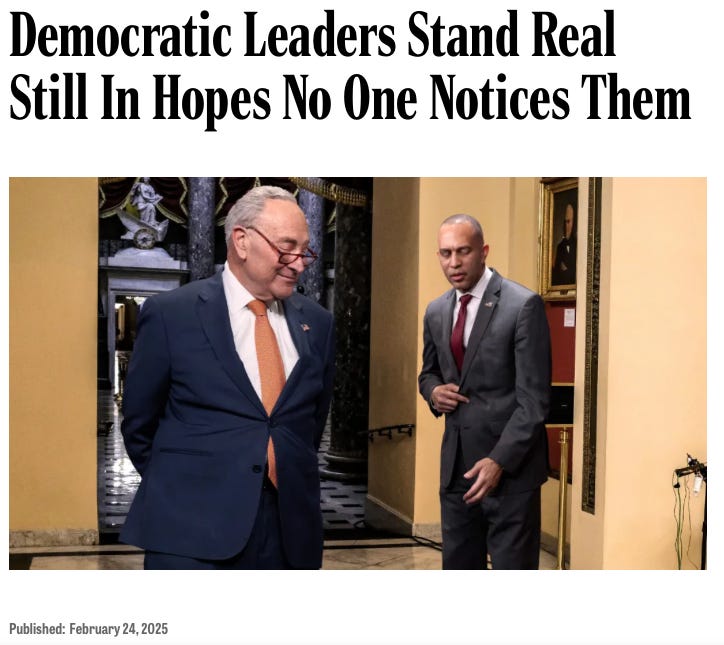
That strategy didn’t work the first time they tried it, and it won’t work now.
Back in 2017, political science professor David Faris, of Roosevelt University, warned that: “Democrats keep waiting for the GOP to destroy itself. This is a huge mistake. By hoping Bannon will blow the whole thing up, Democrats are playing with fire.” Current events have proven him right; waiting for, and encouraging, the GOP to burn itself down turned out to be supremely dumb, bringing about the current incineration of federal governance.
Yet the bigger and more serious mistake the Dems and their allies are making—an erroneous assumption that most commentators aren’t talking about and oftentimes buy into—is the underlying story they’re telling themselves, that the previous order can even be restored in the first place. When in fact…
THERE. IS. NO. GOING. BACK.
That world is done. Kaput. As Noah Smith said in a recent article in Noahpinion:
I believe that what we’re seeing today truly is the end of an era, an epochal overturning of the world as we knew it, and that the full import and implications of this haven’t really struck us yet.
We’re all desperate to think that the world we grew up in isn’t gone, and that it’s merely awaiting a restoration. The other night comedian Jimmy Kimmel joked that he just wants to be comatose for the next four years. Watch CNN or MSNBC and you’ll hear anti-MAGA, former Republicans give some version of the line that they look forward to the day when we can all just get back to boring stuff like debating marginal income tax rates.
It’s a common fantasy narrative: we just need to wait it out for four years, as we fight to return America to some sort of national common sense, and then restore the consensus, bi-partisan, give-and-take, pluralist world that held for decades before this disturbing upheaval.
Here is the truth, and it’s a hard pill to swallow: Our fundamentalist faith in the durability of the old order was wrong. And it’s proving just as untrue overseas as it is here at home, as right-wing parties climb the ladders of power all over the world. Even if, by some miracle, the pre-existing order could be restored temporarily, it has proven itself inherently unstable and unsustainable: economically, politically, and most important, narratively. It had a great 80-year run, but it’s over, and it’s time we got right with the idea that we need replace it with something entirely new.
Hoping for the impossible, and trying to force the nation backward, will only lead to further victories for the right.
We need to pause, take a breath, and accept that a central story of our collective identity is finished. Devastating? Yes. In the prescient 2019 British TV series Years and Years, from Russell T. Davies, we get a beautiful, sad monologue from a family matriarch, over a family dinner, as the UK descends into fascistic autocracy. She laments her foolishness in assuming that the ideology of the mid-20th century had it all figured out:
Ten thousand days is the blink of an eye. Ten thousand days ago I was here in this house… and I thought, ‘Here we are. We’ve done it. Nice little world. Well done, the West. We’ve made it. We’ve survived.’
What an idiot. What a stupid little idiot I was. But I didn’t see all the clowns and monsters heading our way, tumbling over each other, grinning. Dear God what a carnival. And that’s all it took. Ten thousand days…
In the end, she puts it down to our collective failure, in large part the fault of a willful blindness in the developed world in seeking material comfort and economic privilege without regard for consequences—she criticizes our willingness to accept an economic order that is in many ways exploitative and dehumanizing. One might quibble with her particular complaint against automation. But the overall spirit of her criticism is hard to refute.
We buy into that system for life…
We can sit here all day blaming other people. We blame the economy. We blame Europe. The opposition. The weather. And then we blame these vast sweeping tides of history like they’re out of our control, like we’re so helpless and little and small. But it’s still OUR FAULT…
This is the world WE built. Congratulations. Cheers, all.
(It’s very much worth watching the heartbreaking, 6-minute clip. And yes, the entire series is a revelation.)
The Story is Over, So What Shall We Write Next?
This is all very disorienting. Inducing a vertiginous nausea when you really consider all the implications of an entire worldview that held for generations collapsing all at once. The sense of order crumbling. It leaves one trying to cling like mad to familiar stories, to preserve our feeling of the world as still making sense.
Even more disconcerting is the recognition of how big and complex our world really is, with all its interlocking pieces. This well-honed system operates according to rules, conventions, assumptions, and reflexive habits, all of which are being torn up right before our eyes. Every day. In ways that likely won’t be reversed.
It’s a gut punch. And yes, it’s preferable to self-soothe with a belief that it can all go back. But we must accept what now is: the current step-change in the operating system of the world is permanent, and as we see it here at LiteralMayhem, there are (at least) two key reasons why we’re never going back: one is narrative, and the other is structural.
FIRST, THE NARRATIVE REASON:
The forces of radical conservatism have been aligned against the project of modern liberalism since the very beginning of the 20th century. Over the past seven decades in particular, they have been plotting and striving, building their media apparatus, honing their message, step by step co-opting the Republican Party, and sowing populist seeds of distrust in, even hatred for, the very idea of government. (For an in-depth review of that seven-decade project see our “BIG Big Lie” series. )
Their deeply rooted identity narrative—that they’re heroes saving the nation from anti-American, capital-L Liberal tyranny—will NOT simply disappear just because some pluralist politicians win an election or two.
Moreover, the central characters pushing a victorious Narrative A have inbuilt momentum behind them. Pam Bondi, no matter her qualifications or her toady loyalty or her twisting of the law, will forever be known as “former Attorney General Pam Bondi.” Likewise for Kash Patel, who will forever be “former FBI Director.” And “former Secretary of State Marco Rubio.” And “former OMB Director Russell Vought.” And “former Education Secretary” Linda McMahon, who “saved American education.”
Though the right loves to denigrate officialdom as the “deep state,” these folks will be celebrated in right-wing media and policy circles as the new and improved officialdom, and they will use their vaunted status as “formers” to lead the conservative movement for decades to come. Most important, however, is that they’ll be the writers of narrative for decades to come, with their “former” status giving the entire panoply of Trump backers the authority to continue rewriting the meaning of American conservatism and redefining the “real America” to reflect their own image.
What we have seen so far is that they are corrupt storytellers. They wield misinformation, disinformation, misrepresentation, and dishonest buzzwords as weapons. Freighted concepts like “pro business” and “religious liberty” and “free markets” and “government tyranny” and “faceless bureaucracy” and “unelected judges” and “weaponized government” are used to manipulate public sentiment on important matters of public governance and Constitutional interpretation.
That leaves any anti-autocracy coalition hemmed in narratively. For example, any future Democratic-led administration won’t be able to suddenly reconstitute the Department of Education once Linda McMahon is done taking it apart. Not only will it be logistically impossible, but the “government tyranny” and “woke bureaucrat” narratives will be too well entrenched on the right to allow for it anyway. That is: if Dems want to win over any persuadable Trump voters in swing states like Georgia, Pennsylvania, Arizona, and North Carolina, arguing for a reconstitution of the federal Department of Education, in its exact previous form and authority, would be one of the surest narrative paths to defeat.
One should bet that the Dems’ storytelling will pursue the most practical route to victory: a kind of Clintonian narrative triangulation. Witness Gov. Gavin Newsom’s embrace of the right’s anti-trans narratives in his effort to prepare for a White House run. Witness also the craven obeyance of Jeff Bezos in rewriting his newspaper’s tag line (retracting its explicit support for democracy), and not just realigning the paper’s op-ed page to support “liberty/free markets,” but explicitly saying they won’t print articles “opposed” to those two ideas. (God only knows how the term “opposed” will be interpreted in practice.)
Once vast swaths of America’s social safety net and governance infrastructure have been dismantled and/or reorganized, those old institutions and processes will be unrecoverable logistically. But more important, they will be out of reach narratively, for any party seeking to be a national majority party.
The ultra-right’s autocratic answer to “What is government?” will have been institutionalized, and that’s what we’ll be stuck with.
The old pluralist answer to “What is government?” has a stake through its heart. Another way to say it: the soil in which pluralistic governance once took root has been poisoned against it. If the pro-pluralism, anti-autocracy coalition is ever going to regain the trust of a majority of voters and sweep away the nationalistic, populist, fascistic storyline now in ascendancy, that coalition needs a credible economic and political storyline that’s entirely new.
SECOND, THE STRUCTURAL REASON
One of the supreme ironies of the MAGA movement is its use of the word “again.” Nobody will put an exact date on when America *was* great, a period to reclaim. But their language harkens back to some mythic time of a thriving middle class, supposedly limitless upward mobility, a gender-normative, single-income nuclear family, and America astride the world. One might legitimately presume they’re talking about the mid-century, post-WWII period—the most recent “great” period within living memory.
(One could argue that conservatives are harkening back to the Reagan years, but that administration itself was nostalgic for a previous era, and was responsible for the original minting of the “make America great” slogan—implying that America had enjoyed previously unmatched greatness.)
However, the policy tools that made America great in the post-war period were exactly the thing that today’s conservatives despise, and have spent decades demonizing and trying to dismantle: high taxes, high public spending, strong antitrust enforcement, strong financial regulation, big infrastructure programs, and expansive social programs that the right derisively calls “social engineering.”
The post-war period was also, as William Finnegan put it in The Long Memo, the “golden age of capitalism.” But as he observes:
The same business elites who had been forced to accept these regulations never stopped trying to undo them.
> They hated high taxes.
> They hated powerful unions.
> They hated financial regulations.
Over the past seven decades, the conservative right, led by a business and moneyed elite, foreclosed any narrative pathway toward reclaiming those structural policy tools by convincing more than half the country that the very idea of “government” is the root of all our economic and social ills.
Their conservative patron saint, economist Milton Friedman, “decided that this whole ‘balance’ thing was a terrible idea,” according to Finnegan. Friedman’s idea was that corporations existed to make money for shareholders and that’s it. Any impingement on the private economy was akin to moral heresy. We’re now living the successful implementation of that “neoliberal” narrative.
But the more serious structural challenge, vis-à-vis our current political crisis, is what came after Friedman: Democratic triangulation and what we could call a “neoliberal compromise.” After the Reagan Revolution, Democrats sensed a permanent step-change in the public mood; so, they tacked their storyline to the middle. Paraphrasing it: “You let us keep much of our government spending and expansive social programs, and we’ll give you your low taxes, reduced regulation, and a massive liberalization of capital markets and trade. We’ll sell it as the best of both worlds.”
It worked for a bit, enabling the Clinton administration to turn budget deficits into surpluses. But in the long run, that neoliberal compromise enabled a decades-long shift toward concentrated market and political power among a small group of wealthy elites and giant corporations—it was the beginning of what Finnegan calls the “slow slide to now.”
So, one can rightly ask: If the strong policy tools of the early- and mid-century are now off the table, can we really expect that restoring the neoliberal compromise will beat back America’s autocratic right wing movement—when that political shift was an outcome of the neoliberal compromise in the first place? No, we can’t.
(As an aside… Yes, racism. Yes, other stuff. There are many drivers of social discontent, but if the neoliberal compromise had delivered economic benefits across the board, as promised, those other drivers and resentments would be much easier to address.)
So why won’t a return to “normal” work?
Here, our challenge finds a parallel in the current AI debate. (Stay with me here.) Hypesters argue that “artificial general intelligence” (AGI) is imminent: i..e, building computers that can perceive, understand, think, and create like humans do, only better. Skeptics argue, convincingly, that it’s a bullshit claim, because the hardware and software infrastructure upon which current versions of artificial intelligence (AI) are built are inadequate to the demands and aims of the more ambitious AGI. Skeptics argue that if AGI is ever to be built—and it’s an open question whether it should be built—we will need a clean sheet of paper, entirely new ideas, and entirely new tools (like quantum computing), to get it done. Current versions of “AI” have hit a dead end. Their story has been fully written. The very structure of today’s AI solutions is what makes them intrinsically unsuitable for the AGI challenge.
Here’s a sharper analogy: Imagine trying to dig a six-foot deep hole using only a rotten banana. Again, the tool is inadequate to the job.
In like fashion, the neoliberal compromise that began in the 1990s is wholly inadequate to the task of rebuilding an economics and politics that a majority of people can have faith in. It is structurally unsuited and unsound. Our current crisis is, in the main, a result of that neoliberal compromise in the first place; Finnegan cites some of its main outcomes as stagnant wages, dominating corporate monopolies, squelched competition, and the labor exploitation of a “gig economy.”
But on a larger scale, the extractive and growth-obsessed practices of global business have exacerbated regional wealth inequality, driving immigration pressure and the destabilizing backlash politics we’re seeing in developed economies, especially in Europe. Those practices are also now crashing through planetary boundaries in terms of species extinction, ecosystem collapse, endemic chemical pollution, outstripping the availability of natural resources, and climate change. Finally, the relentless, and often manic, pursuit of growth in the field in which I have worked for 30 years (finance) has led to a dehumanizing “financialization” of everything, which Finnegan calls “making money from money.” Our lives, habits, decisions, and even our beliefs and perceptions exist merely to generate basis points of return on a spreadsheet.
In practice, to earn above-market returns (i.e., “alpha”) investors have been pushing deeper into esoteric asset classes. Shifting allocations to stocks and bonds off into commodities, and into private equity, and venture capital, and hedge funds, and other “alternatives,” and now into the monetization of every aspect of our lives. Professional investors and huge, monopolistic businesses use their pools of money to squeeze profit and “alpha” out of the smallest and most basic tasks of living, by buying up and financializing everything in sight, from rental housing, to your local doctor’s office, to the local lakeside boat dock, to vending machines, right down to our attention span and social relationships.
In another bit of irony, we live in what could legitimately be called an economist’s paradise: an increasingly frictionless world of high labor mobility, highly liquid, deregulated, and transparent capital markets, and growing international trade. But what’s great for business has delivered devastating social outcomes: discontent and dislocation, increasing economic hardship and inequality, and frustrated, angry politics that seeks more and more extreme solutions for people’s pain.
So what story are we to write now?
Big government is dead, practically and narratively. Pure neoliberalism is exploitative, anti-humanist, and wildly inequitable. And the neoliberal compromise has been an abysmal failure at lifting-all-boats. The tools we’ve already tried are not up to their intended task; and the marketplace of ideas, as consistently expressed through “protest voting” over the past two decades on the right and the left, has rendered its final determination. The jig is up.
Help Wanted: A Radically New Narrative of the Possible
TechDirt made a stunning assertion in a recent post, that the site is “now a democracy blog (whether we like it or not).”
When the very institutions that made American innovation possible are being systematically dismantled, it’s not a “political” story anymore. It’s a story about whether the environment that enabled all the other stories we cover will continue to exist… When you’ve spent years watching how some tech bros break the rules in pursuit of personal and economic power at the expense of safety and user protections, all while wrapping themselves in the flag of “innovation,” you get pretty good at spotting the pattern…
But what’s happening in the US right now is some sort of weird hybrid of the kind of power grabs we’ve seen in the tech industry, combined with a more traditional collapse of democratic institutions. What we’re witnessing isn’t just another political cycle or policy debate — it’s an organized effort to destroy the very systems that have made American innovation possible. Whether this is by design, or by incompetence, doesn’t much matter (though it’s likely a combination of both). Unlike typical policy fights where we can disagree on the details while working within the system, this attack aims to demolish the system itself.
The truth is that the system itself has already been demolished because faith in the system has been demolished. (Just like how the value of money depends on faith, and our mutually agreed belief in it.) It’s only a matter of time before reality catches up.
Witness Europe moving on from America in a “fool me twice shame on me” kind of way, what France’s Europe Minister referred to as “a whole portion of Europeans waking up after refusing to see the reality of things.” They are embarking on an independent strategic path from America in both economics and defense. Canada the same, as expressed by its new PM:
We will have to do things we haven’t imagined before, at speeds we didn’t think possible. [...] I know, I know that these are dark days, dark days brought on by a country we can no longer trust. We are getting over the shock, but let us never forget the lessons: we have to look after ourselves and we have to look out for each other. We need to pull together in the tough days ahead.
Even Australia is considering breaking with the U.S. to join the “coalition of the willing” to defend Ukraine.
None of this is reversible.
In the context of this broken system, listening to feckless Democrats is like enduring dental work without anesthesia. While we love the idea of “hopium,” it’s painful to listen to Dems and their allies endlessly plotting their strategy for regaining power without radically rethinking what they’ll actually do with power once they get it. It’s all “fight/protest/organize,” a Democratic version of repeal-and-replace: a call to dump the current regime without proposing something better that’s actually workable.
Likewise, some conservatives argue that the solution is a third party. But while an article in The Bulwark admits that “aimlessly doing the same old thing does not rise to the moment,” it only advocates for “adding a new voice to the party system” (i..e, a third party to compete and win red states) as a way to “back away from the brink of chaos and corruption.” The prescribed solution?
Being tough on the border, moderate-to-conservative on cultural issues, but populist on economics, and most importantly, unafraid to combat the crony capitalism of the Trump-Musk axis of greed and in favor of Congress fighting back for the rule of law and accountability.
There is no actual proposal here to depart from the neoliberal compromise founded in the 1990s that led exactly to where we’re at now. It’s all just, grab your rotten banana and start digging. What does being “populist on economics” entail?
Higher corporate taxes? Not happening.
Higher taxes on the wealthy? Not happening.
Supporting union power? Not happening.
Investments in training and education? Not happening.
Blue collar jobs in infrastructure? Not happening. (And those workers with good, Bidenomics infrastructure jobs voted for Trump.)
Domestic investment in manufacturing that empowers workers rather than high-tech monopolies? Not happening.
Empowering gig workers and tipped workers? Not happening.
Pulling back on the financialization of everything? Not happening.
The ultra-right that now owns the Republican Party is no friend of “populist economics.” And as expressed above, the soil of voter sentiment has been poisoned against it. All the policy tools that could enable a system of populist economics are narratively verboten as systems of oppression: violations of the “liberty” and sanctity of “free market capitalism” that form the beating heart of the “real America.”
And let’s say it again, to be absolutely clear: even if the Dems and their allies manage to win a few national elections, that does NOT change the overall trajectory of where we’re headed. It won’t fix anything. At best it’s temporary relief.
The world desperately needs a “Darwin moment” or a “relativity moment” or a “moonshot moment” or in current-events terms, a “Deep Seek moment”: a discovery or radical reframing that resets our belief system and opens vast new horizons for what’s possible in the world.
Now, those kinds of narratives often take a long time to reach full flower—decades, if not generations. Just as the fringe conservatives of the 1950s planted seeds that took seventy years to blossom into the sudden, global restructuring we’re seeing today. Perhaps a new planet- and humanity-saving idea will be some version of de-growth. Perhaps something more radical. Perhaps something less. There’s not enough expertise here to know what would work.
But here’s what certainly WON’T work: living within the current boundaries of what we perceive to be possible.
As Noah Smith observed:
Over the past decade and a half I’ve watched in dismay as the real-world communities and families I knew in my youth got ripped up and replaced with a collection of imaginary online identity movements. I’m still waiting for someone to figure out how to put society back together again — how to do what FDR and the Greatest Generation did a century ago. Looking at the Trump movement, I’m pretty sure this isn’t it.
But that’s what we’re stuck with now, and it’s not going anywhere any time soon. Their storyline of American restoration won, and it’s not just reshaping America, but the entire world.
Step back. Pause. Rethink.
We have to accept the fact that the fundamental narrative that has bound our world together for generations is irreparably broken—even if our nostalgia and fear don’t want to let us admit it. Worse, we also have to admit that our current tools are not up to the task of fixing it. In fact, the policy tools in place for the past several decades are what got us here.
If we want to restore small-d democratic freedom and pluralism, in a more stable and sustainable form—if we don’t want to live in some techno-feudalist, autocratic hellscape—then sticking with different iterations of what we already know is woefully insufficient.
So what now? First, we need to get past the comforting story of going back to the old ways, and admit that it’s a fantasy.
Next, the economics and political science professions need to put on their big-people pants and get to work, and give us some truly revolutionary way forward. Because the revolution currently being foisted on us, powered by the finance and technology professions, is eating the humanist world alive. It’s an autocrat’s dream storyline, and we need a new way out, because the old world is dead. The way is shut. There’s no going back.
I think you might have things backwards. You touch on economics more as an outgrowth of political narratives, but I think that the opposite might be true:
What if we are living through the collapse of the liberal capitalist narrative that has existed since the late 18th century, and the political narrative collapse that you correctly identify is an outgrowth of the lack of an economic vision that describes a better future?
You seem to come close to a deeper discussion about economics as the root when you talk about how the current economic order is created ecological systems collapse while leaving millions or billions of people in near slavery. I was kind of surprised when reading this that you didn't mention any of Mark Fisher's ideas about capitalist realism, specifically him building off a quote from the philosophers Fredric Jameson and Slavoj Žižek "It's easier to imagine the end of the world than the end of capitalism", as well as his ideas around a deep nostalgia for a lost future (maybe you aren't familiar with him though).
We seem stuck in that place where nearly everyone can see that things don't work but a lack of imagination about a different future leaves us rehashing old narratives hoping this time they'll work, or accepting strongman narratives of power dynamics and the law of the jungle to try and grab as much as possible so that others can't have it. At the end of the day though, as James Carville said, "It's the economy, stupid."
Using the economic narrative model I'm suggesting, the authoritarians are saying, "see Chinese autocratic quasi-capitalism is strong, we can do that too if we give up on democratic ideas (but pay no attention to the possibility that its all a facade to scare people from challenging them or to the neofeudalist oligopoly that would result if we do that here)", while the old liberal order is saying "uhhh...lets keep doing what we've been doing economically (even though that hasn't worked for millions / billions of people) and uhhh...I guess try and make it suck a little less around the edges", and the political narratives then fall out of those competing economic visions - or lack of vision in the latter.
It's a really really scary thought though, because Jameson and Žižek were totally correct - it really is easier to imagine the end of the world than the end of the Westphalian liberal capitalist order. I feel like it might be something you almost considered when writing this, but shied away from it because of the frightening enormity that follows when you actually say it out loud. What does the end of our current concept of liberal capitalism even mean? What does come next? How should we aspire to create a society that delivers better standards of living for everyone while not trashing the planet? What chaos will result as we figure that out?
Also, I'm not saying this to suggest that any old idea like socialism / communism is the prescription either. Those are narratives were responsive to and bound up with the classic-liberal capitalist narrative, and have failed to deliver a better future in their own ways...They are also broken narratives.
Point is, we aren't going to magically get to a successful purely political narrative that works to combat the rising authoritarian tide without that being based on the needs of an economic narrative that gives people a reason to believe that the political implementation of those ideas will actually deliver a better future for people and their families.
Agree that won't be easy to put Humpty Dumpty back together again easily. Unfortunately, IMHO it will have to get much worse before it gets better.